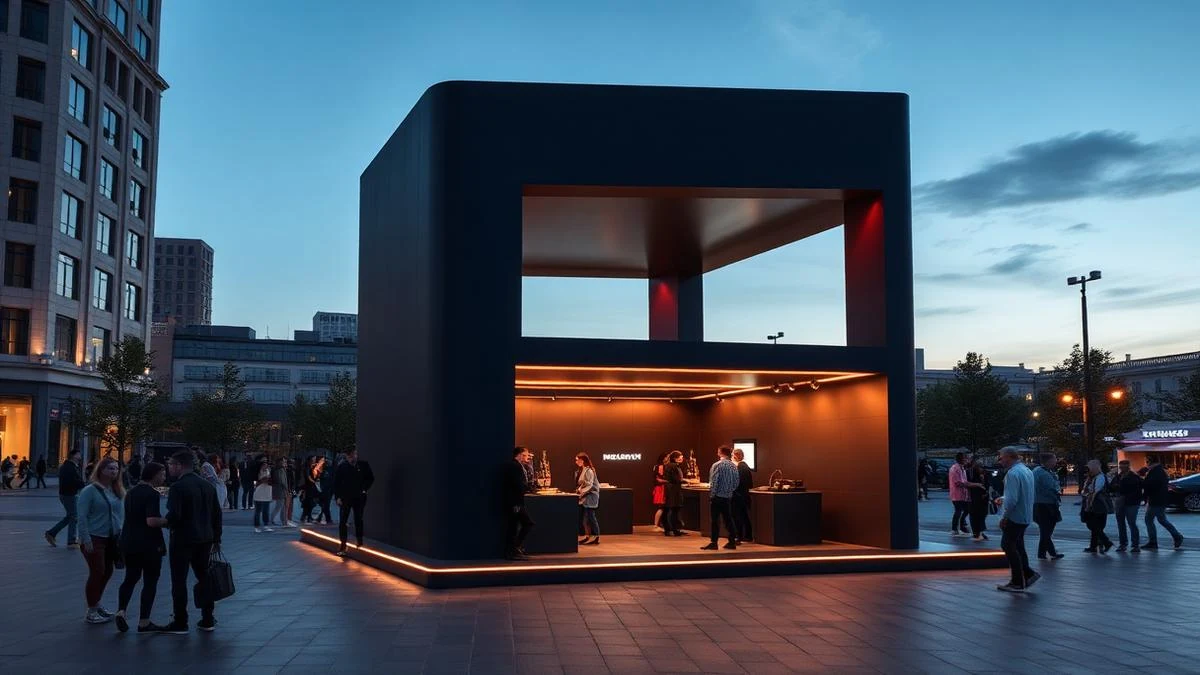

Short answer: Brand activation is a real-world or experiential campaign designed to make people interact with a brand rather than passively see it, with a specific behavioural objective such as trial, data capture, earned media or a measurable shift in perception. The formats vary widely — sampling, pop-ups, sponsorship activation, trade stands, stunts — but the ones that work in Australia all start with an objective before an idea, and are measured against something more concrete than "we got lots of engagement".
What brand activation actually means
Brand activation is any campaign designed to make people interact with a brand rather than passively see it. The distinction that matters isn't format — pop-up, sampling, stunt, installation — it's intent. An event exists to gather people. An activation exists to change what those people think, say or do about your brand afterwards.
This is a subtly different job to most of the rest of a brand identity project, which builds the system a business shows up with. Activation puts that system in front of a live audience and asks it to do something in real time.
Activation vs event vs sponsorship
- An event is a gathering: a launch, a conference, a client function. Success is attendance and experience.
- An activation is a designed interaction with a specific behavioural objective: trial, data capture, content generation, earned coverage or a measurable shift in perception.
- Sponsorship buys association. Sponsorship without activation is a logo on a banner — which is why the money spent activating a sponsorship usually matters more than the rights fee itself.
Formats that work in Australia
- Sampling and trial. The oldest format and still the most reliable for consumer products, because trial is the shortest path to purchase. Works hardest in high-footfall retail and transport hubs, and at events where the audience is already in the right mindset.
- Pop-up retail and installations. Effective for brands that are digital-first and need physical credibility, particularly in Melbourne laneways, Sydney's inner suburbs and major shopping precincts.
- Sponsorship activation. Turning an existing sports, arts or festival partnership into an actual experience. Australia's sporting calendar makes this a crowded but proven space.
- Trade and B2B activation. Underrated. A well-designed trade stand with a genuine interaction — a live demo, a diagnostic, a data giveaway — outperforms brochure tables at every industry expo.
- Stunts and earned-media plays. Highest variance. When the idea is genuinely newsworthy the media value dwarfs the production cost; when it isn't, you've paid for a handful of social posts.
Format choice should follow the audience and objective rather than the other way around. A B2B business chasing a trade audience gets little from a laneway pop-up, and a consumer brand chasing trial gains little from a trade stand.
The strategy underneath
Activations fail for a consistent reason: the idea is chosen before the objective. Any competent event and brand activation agency runs the sequence the other way.
- Define the behavioural objective. Trial? Email capture? Earned coverage? A shift in a specific perception? One primary objective, not four.
- Define the audience and where they physically are. Location choice does more for results than production budget.
- Find the hook. The reason a stranger stops walking. If you can't articulate it in one sentence, passers-by won't work it out either.
- Design the capture mechanism. How does the interaction become something you keep — an email address, a piece of content, a review, a media pickup?
- Plan the amplification before the day. The activation reaches hundreds; the content and PR around it reach the rest. Photographers, media invites and social assets should be locked in beforehand, not scrambled afterwards.
Measurement: what to actually track
Footfall is a vanity number. Track the metrics tied to your objective: interaction rate against passing traffic, samples or demos delivered, data captured and its subsequent conversion rate, earned media reach and quality, user-generated content volume, and branded search lift in the days following. Branded search is the most underused signal here — a genuine attention spike shows up in search demand almost immediately.
Set the benchmark before you run it. Comparing an activation to "we got lots of engagement" is not measurement; comparing cost per qualified interaction against your paid media cost per lead is.
It's also worth tracking how the data you capture performs after the event. A pile of email addresses from a sampling activation only proves valuable if those contacts are followed up and converted, so the activation's real return often isn't known until weeks later.
What it costs
Small sampling activations at a single site can run in the low tens of thousands once staffing, permits, product and production are counted. Multi-city programmes with custom builds scale well beyond that. The two costs consistently underestimated are permits and council approvals — which in Australian CBDs take longer than people plan for — and staffing, since brand ambassadors need training and supervision to represent you properly.
Weather and seasonality also affect cost more than most budgets allow for. An outdoor activation needs a wet-weather contingency built in from the start, not added as an afterthought once a forecast turns.
Agencies running activations at scale also build in a debrief stage that many brands skip: reviewing footage, staff feedback and captured data within a week of the event while it is still fresh, rather than months later when the next campaign has already taken priority. That debrief is often where the sharpest insight for the next activation comes from.
Planning timeline
A single-site sampling activation can usually be planned and delivered within six to eight weeks, covering concept, permits, staffing and production. Larger multi-city programmes or anything requiring council approval in a major CBD needs considerably longer, often three months or more once permit lead times are factored in. Building in this lead time upfront avoids the common trap of compressing production into a rushed final fortnight. This is doubly true for anything requiring a permit in a Sydney or Melbourne CBD, where approval timelines are the single most common reason a launch date slips.
When not to do one
If your brand identity is inconsistent, an activation amplifies the inconsistency in front of a live audience and a camera. Get the system right first — the difference between a mark and a system is covered in brand identity vs logo design. And if the objective is direct lead volume this quarter, paid media will almost always beat an activation on cost per lead.
When the objective genuinely is attention, trial or earned coverage, Odin Digital designs and runs the concept, logistics and post-event amplification as an event and activation agency, measured against a defined objective rather than a photo gallery.
Briefing a provider: what to ask before you sign off
A proposal for an activation should answer a handful of practical questions before it gets anywhere near a creative concept. Ask what the primary behavioural objective is and how it was chosen, who owns the permit applications and by what date they need to be lodged, what the wet-weather or fallback plan is, and how staffing will be trained and briefed on the day. If a proposal jumps straight to the idea without addressing these, the idea is likely to be the least reliable part of the plan.
It is also worth asking who owns the debrief and when it happens, since an agency that has already scheduled a review of footage and data before the event runs is signalling how seriously it treats measurement.
Common failure modes
Most underperforming activations fail in one of a small number of predictable ways. The idea is chosen for its novelty rather than its fit with the audience, so it draws a crowd that has no relationship to the buying decision at all. The capture mechanism is an afterthought bolted on the week before, so the data collected is thin or poorly structured for follow-up. The location is chosen for convenience to the agency rather than proximity to the actual audience. And the amplification plan — photography, content, media invites — is scrambled together on the day instead of locked in during planning, so the reach beyond the physical footprint ends up far smaller than it should have been.
A worked example of the shape of the calculation
Rather than inventing figures, it is more useful to describe how a business should model the return on an activation before committing budget. Start with the number of qualified interactions you realistically expect at the chosen location and time, based on comparable foot traffic or past event attendance. Apply your existing conversion rate from a qualified lead to a customer, drawn from your own sales data rather than an industry benchmark. Multiply that by your average order or contract value to get an expected return, then compare that figure against the full cost of the activation — production, staffing, permits and contingency — to see whether the maths make sense before the concept is finalised. If a business cannot estimate that conversion rate, sales tracking needs fixing before any activation format is chosen.
How results should be reported back to you
A proper post-activation report separates the objective metric from the vanity ones. Footfall and photos are context, not results. Expect a report that states the objective agreed beforehand, the metric tracked against it, the raw data captured, and an honest read on what worked and what did not — including anything that underperformed. If a report only contains a highlight reel and total attendee estimate, ask where the data capture, conversion tracking and branded search data went.
Activation as part of a wider content programme
An activation that only exists on the day it runs is wasting most of its potential value. Photography, footage, attendee-generated content and any media coverage should feed a content calendar that runs for weeks afterwards, not just a single wrap-up post. Businesses that treat the activation as the start of a content cycle rather than the end of one tend to get more out of the same production spend, since the cost of capturing usable content on the day is marginal compared with the cost of producing it separately later. Where the activation is one piece of a broader repositioning, it also pays to sequence it with the rest of the work a branding agency would ordinarily run — messaging, identity and rollout — so the live experience says the same thing as everything else a buyer will encounter afterwards.
Where to go next
- Event and brand activation agency — concept, logistics and amplification for activations that need to prove a result.
- Brand identity design — get the underlying system right before you put it in front of a live audience.
- Brand identity vs logo design — why a consistent system matters more than a single mark.
- Signs your business needs a rebrand — for brands weighing up a bigger change before activating.
- Content marketing strategy — turning activation content into an ongoing programme rather than a one-off spike.